Inside the New Era of Software Building
The AI movement is in full swing. Across companies, teams are learning how to build faster, work together more fluidly, and turn ideas into software at a scale we’ve never seen.
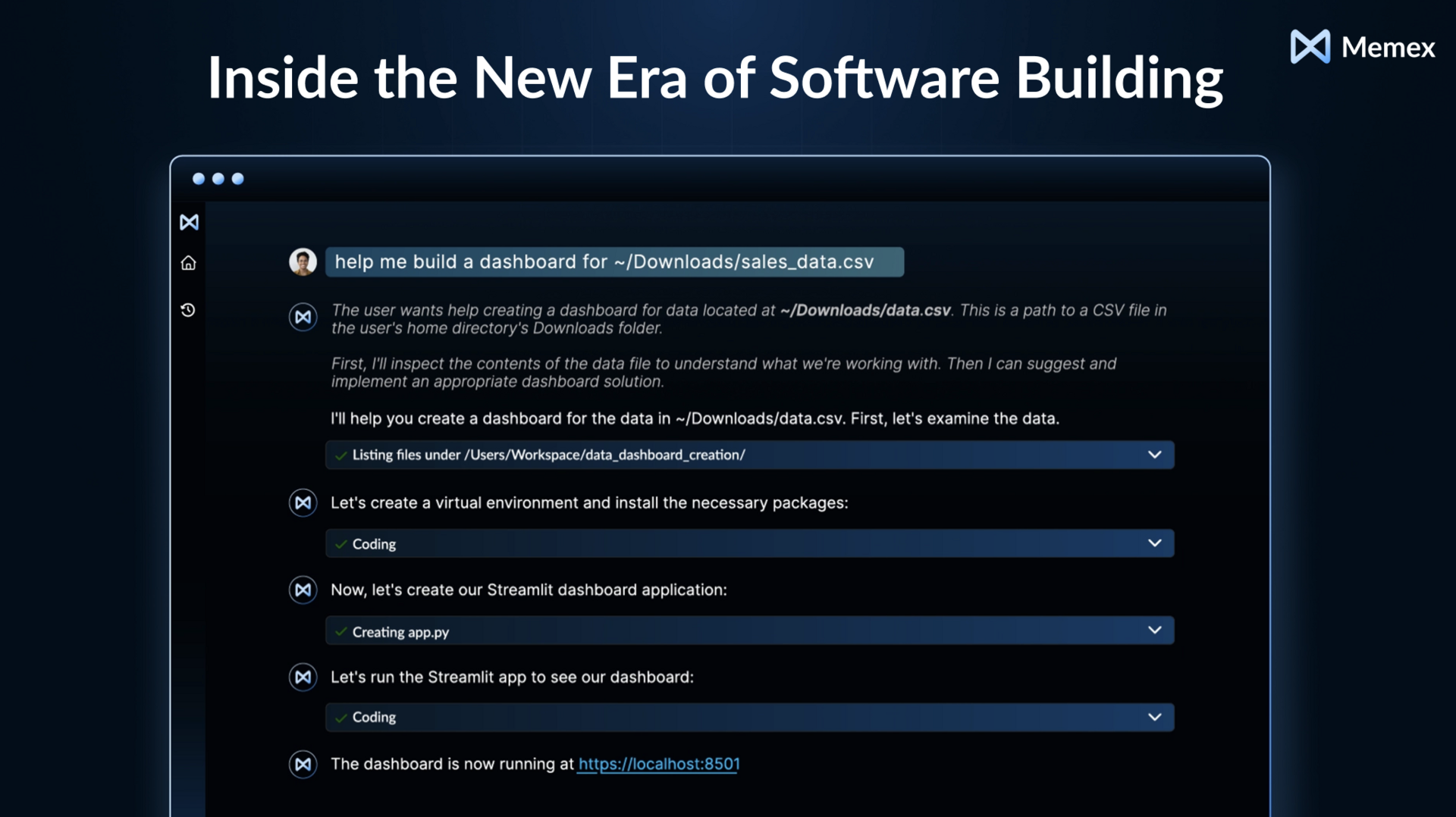
In 2025, AI-powered development isn’t a preview of the future. It’s the standard way to build software.
This is the second article in our three-part series on software creation, and how it’s evolving. Part 1 traced the path here, from traditional coding to low-code and AI-assisted building. Now, we’re exploring the present: how companies use these tools, how teams are adapting, and what this means for productivity, collaboration, and speed.
Everywhere you look, change is visible. Engineers using AI to finish routine work in minutes. Product managers translating ideas into prototypes without writing a single line of code. Designers and analysts describing a goal in plain language and seeing it turned into a functioning system.

What began as small experiments has grown into a shared workflow, where people and intelligent systems build together. The result isn’t just faster code; it’s a new type of collaboration that’s rooted in creativity, intent and problem-solving.
AI systems like Memex mark the next step in that evolution. In addition to coding, they can plan, reason, and work alongside humans as true engineering partners.
The Modern Way to Build
Today, there are two main paths into software creation.
One is led by traditional developers who use AI.
The other by newcomers—domain experts, analysts, and researchers—who are writing code for the first time.
For the first-time builders, tools like Memex and other agentic coding platforms help them describe what they want in plain language and see it come to life. People who once relied on engineers can now build independently, unlocking new levels of productivity, creativity, and access. As more voices shape the tools they use, entire industries are becoming more adaptive and innovative.

Whether someone is an experienced engineer or a new builder, their workflows are remarkably similar. They explain what they need, test what the AI produces, and refine until it matches their intent. The process feels less like writing code and more like shaping it through conversation.
In practice, here’s how it looks:
Language as creation. Ideas now move directly from plain speech into working code. Communication itself has become a new form of programming.
Shared intelligence. Builders no longer work in isolation. They draw on a collective layer of reasoning that spans tools, data, and models.
Guided exploration. AI does more than follow instructions. It surfaces alternatives, proposes improvements, and helps people evaluate tradeoffs in real time.
Human amplification. Rather than replacing expertise, AI expands it. Builders spend less time assembling code and more time applying insight, judgment, and design.
Continuous understanding. Each interaction teaches AI how teams think, allowing it to provide more adaptive, intuitive support as projects evolve.
In Memex, this workflow is able to access and manage resources across environment, with state and reasoning preserved. It’s not a prompt-and-response exchange; it’s a collaboration that grows over time, where the AI remembers intent, structure, and context from every interaction.

According to a GitHub survey, the adoption of AI among US developers is nearly universal. What matters most today is not how well someone writes code, but how clearly they can express ideas.
Memex is designed around that principle. Acting as an AI software engineer, it works alongside humans to plan, reason, and deploy working systems from natural language. It adapts to how people frame and articulate problems, turning collaboration itself into the interface.
The Citizen Developer Boom
Beyond professional developers, another wave is transforming how software gets built: citizen developers. These are business users who create applications and automations through low-code and no-code platforms instead of traditional programming.
Key indicators of this trend include:
Increasing support among companies for citizen developers.
It’s been projected that 80 percent of tech products and services are now built outside of IT.
By 2022, Microsoft’s Power Platform had already surpassed 20 million builders.
At the moment, GitHub’s developer community alone is more than 150 million strong.
The outcome is a more distributed model of creation: professional developers remain vital for scale and architecture, but they now share the creative frontier with millions of peers across every department.
Inside companies, this shift moves problem-solving closer to the source. Operations teams now automate their own workflows. Finance leads build dashboards that refresh automatically. Researchers model data without waiting for an engineering sprint. Each new builder expands capacity, without increasing headcount.
However, these gains only last when new creations can connect to the tools and data that a company already relies on.
Many platforms limit builders to a fixed “stack” of compatible components; it’s like being handed a box of Legos where only certain pieces fit together. Memex removes that restriction. It can connect to diverse data sources and environments, from CSV files on a laptop to databases like BigQuery or Snowflake, allowing people to combine information however they need. Memex is also the agentic coding tool that can use and leverage the most diverse number of databases, programming languages, and CLI tools.

This kind of flexibility has traditionally been reserved for engineers who could write code to bridge systems. Memex now brings that capability to everyone, turning plain language into functional apps and workflows.
The Speed of Collaboration
As more people use AI-powered tools, collaboration itself is changing. Software development is no longer restricted to a chain of handoffs. Instead, it unfolds as teams work together, exchange ideas, and watch projects take shape.
A marketing analyst can design an internal app in the morning and refine it with an engineer that afternoon. A support manager can work with data scientists to automate a weekly report that once required manual input from multiple departments. A product designer can collaborate with developers to turn interface mockups into working prototypes in a single session.

AI acts as a bridge, turning ideas into actionable steps, and keeping teams aligned throughout a development cycle.
With Memex, that process becomes even more fluid. Teams share a continuous workspace that carries context across conversations. A project can begin in a browser and continue on a desktop, with the AI software engineer tracking every decision and state along the way.
In speaking with Memex users, we’ve found that speed has become one of their clearest measures of productivity. Feedback loops that once stretched over weeks now close in hours. Teams can test, learn, and adjust at a continuous rhythm of iteration. More than ever, software creation looks and feels like product design: visual, collaborative, and guided by rapid feedback instead of dense documentation.
A Culture of Review and Trust
As progress accelerates, it also brings new responsibilities. When AI writes code, review becomes about understanding reasoning rather than checking syntax. Teams now document which models were used, what prompts shaped the results, and how the logic was validated. The added context ensures work remains reproducible as systems evolve.
This focus on transparency is central to how Memex operates. Each project records its reasoning history, including prompts, decisions, and iterations, so teams can trace how a system was created. That visibility builds confidence that every output is verifiable and aligned with intent.
For builders, these practices have become essential for maintaining trust in their tools.
Documentation and review are no longer obstacles to speed; they’re what sustain it. Clear records show not just what was built, but why it works. Teams that conduct peer reviews of AI-generated code, track decision paths, and flag uncertain outputs can build frameworks that are refined and enhanced over time.
The key lesson: confidence in AI comes from visibility, not blind acceptance. The most effective teams are those that treat AI as a partner. Something to guide, question, and improve with every cycle.
Building Across Environments
Software development no longer happens in one place. A project might involve files stored locally, data hosted in the cloud, and multiple systems working together in real time. Memex bridges these environments from where it runs, giving builders the ability to access local and cloud resources within the same workspace.

In practical terms, this means Memex can run a local script, query data from a remote database, and link APIs or command-line tools in a single session. This allows users to combine insights from multiple systems without switching platforms. It leads to:
Improved coordination. Distributed teams can contribute in parallel without waiting for code merges or long review cycles.
Faster experimentation. Product managers can test and iterate on ideas directly, shortening the path from concept to validation.
Efficient focus. Engineers spend more time on system design and performance instead of environment setup.
Adaptive context. AI keeps track of dependencies, intent, and prior edits, allowing smooth transitions between people and platforms.
Unified visibility. Everyone can see progress, provide input, and align on goals, whether they’re working locally or in the cloud.
At Memex, our platform is designed to help users work across their tools and data, wherever they live. If something can be accessed through code—whether via an API, CLI, or MCP—Memex can help you build it.
The People Behind the Code
The most important change in 2025 isn’t the rise of AI itself, but how teams are learning to work with it.
Software creation has become more human, and intelligent systems now amplify the traits that make good builders exceptional: being curious, creative, and skilled at solving problems. Companies that view AI as a colleague, not a shortcut, are learning faster, iterating more confidently, and producing stronger results.
At Memex, we call this philosophy software maximalism: the belief that software is more than a collection of apps or tools. It’s the foundation of modern life. When more people can shape the technology they rely on, the world becomes more adaptive, and progress accelerates.
This is what we mean when we say that Memex isn’t an app builder or an assistant. It represents the next generation of engineering itself. By bringing intelligent systems closer to human intent, Memex allows people to do far more than they once thought possible.
In the final part of this series, we’ll explore what happens once this transformation scales, and reaches its full potential. When hundreds of millions, and eventually billions of people, can build software as naturally as they reason, speak, and imagine.
Want to join the new era of software building? Join the tens of thousands of users already building with Memex, and join our Discord community for support and recommendations!